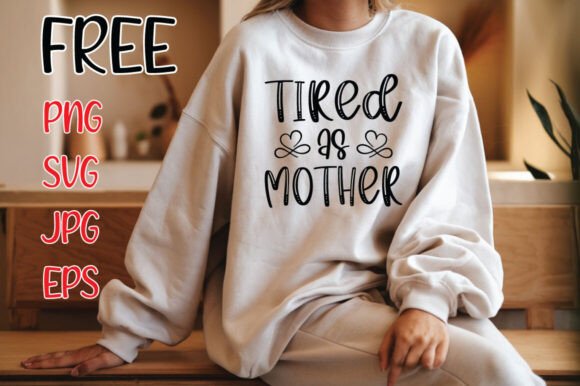
Tired As Mother, MOM SVG, Sublimation
When I first opened the file folder for Tired As Mother, MOM SVG, Sublimation, I wasn’t hunting for a ready-to-stitch embroidery file. I knew going in that this was a graphics asset—PNG, SVG, JPG, EPS—packaged for sublimation and general craft use. But as a designer who digitizes her own embroidery projects, the SVG immediately caught my eye. The vector outline is the cleanest starting point you can ask for. What I wanted to see was whether this artwork had the right bones to transform into a machine embroidery design that would look polished on a finished product, not just pretty on a screen.
What the Artwork Actually Feels Like
The phrase “Tired As Mother” lands with a wink and a deep exhale. It’s the kind of truth that makes a fellow mom snort her coffee. The lettering—likely a mix of playful script and a stable sans-serif for the word “MOM”—carries that exhausted-but-charming energy. There’s no overdone décor, no unnecessary flourishes. That restraint is a gift when you’re planning an embroidery project. Too many thin swirls or tiny disconnected dots, and you’re fighting thread breaks and lost detail. This design keeps its personality through shape and proportion, not fuss.
I could already picture it stitched out. The bold characters would read well from across a room. The lighter, handwritten feel of “Tired As” would soften the message, making it more relatable than confrontational. It’s a design that says, I see you, and I brought snacks.
Real Project Thinking: The Tote Bag That Started It All
My client wanted a custom embroidered tote for her sister, a new mom who had stopped sleeping roughly four months prior. She wanted something funny, honest, and wearable—not another “Mama Bear” cliché. I pulled up the Tired As Mother, MOM SVG in my digitizing software and began mapping out how the letters would translate into satin stitch and fill stitch. The SVG was crisp, with clear path boundaries. No jagged artifacts, no mystery nodes that make you question your life choices. That’s a big deal when you’re converting a graphics file into an embroidery file. Messy vector art turns into messy stitching, and messy stitching kills a handmade gift’s perceived value.
For the tote, I chose a medium-weight canvas. I knew the “MOM” lettering would need a dense but not too heavy satin stitch, because the fabric’s weave would show through if I went too light. The script portion begged for a slightly smaller running stitch underlay to keep those curves from shifting. I digitized the design at about 4.5 inches wide, knowing it would fit comfortably in a 5x7 hoop and leave room for a decorative border if the client wanted one later.
Where This Design Shines in Embroidery
After stitching out a sample on a scrap of cotton canvas, I could see the immediate appeal. The text holds together beautifully even when scaled down to about 3 inches, which means it fits a baby embroidery onesie, a cap front, or a small embroidered patch. The absence of tiny sharp serifs or hairline details makes it forgiving for beginners who are still learning how to fine-tune stitch density. You don’t need to be a digitizing wizard to get a clean result, as long as you respect the basics.
On a sweatshirt, the design felt almost like a brand mark. It had that boutique look—something you’d find at a craft fair table or in a well-curated Etsy shop that sells handmade products for new moms. The humor is universal, so the product fit stretches across tote bags, aprons, pillow covers, tea towels, and even a kitchen towel set for a “desperate but devoted” mother’s day gift. I could also see it on a custom apparel line—maybe a relaxed-fit tee or a baseball cap—where the buyer wants to advertise their sleep-deprived status without saying a word.
Watch Out for These Real-World Stumbling Blocks
No design is flawless, and the Tired As Mother, MOM SVG does come with a few quiet warnings. First, the file is a graphics asset, not an embroidery file. You’ll need to digitize it yourself or hire someone to do it. The store description doesn’t promise a DST or PES version, so set your expectations right. If you’re an Etsy seller who only works with ready-to-stitch files, this means an extra step. But if you’re comfortable with digitizing, the SVG is exactly what you want: clean, scalable, and free of the compression artifacts that plague a JPG or PNG.
Second, the lettering style—whatever font it is—needs careful attention when you plan the stitch angles. If the “T” in “Tired” has a long crossbar, a simple left-to-right satin stitch might cause puckering on thin or stretchy fabric. I always test on a scrap of the exact fabric I’ll use for the final product. For a baby onesie, that means a soft cotton interlock with a ballpoint needle and a cut-away stabilizer. For a cap, I’d add a heavy backing and increase the pull compensation slightly, because the curved surface can distort tall letters.
Third, dark fabrics are not your friend if you’re stitching this design in pastel or muted thread colors. The phrase leans on its emotional punch, and that punch fades if the thread blends into the background. On a navy sweatshirt, I’d use a bright white or a golden yellow to make “MOM” pop. On a light gray tote, a charcoal thread kept the tone gentle but legible. Always stitch a sample in black and white before committing to your final thread palette. It reveals missing contrast faster than any color mockup.
How the Design Affects Your Product Value
What I love about using Tired As Mother, MOM SVG, Sublimation in a real embroidery project is the lift it gives to a simple product. A plain tote becomes a statement piece. A basic sweatshirt turns into a conversation starter. That emotional connection is what drives customer trust and repeat sales. When someone sees the finished item, they don’t just see a funny phrase—they see their own life reflected. That’s the kind of recognition that transforms a handmade product from “cute” to “must-have.”
For small business owners, this design also supports brand consistency. The clear, no-nonsense typography doesn’t fight with your shop’s aesthetic. You can drop it onto a printable mockup for a digital product preview, or stitch it out for a boutique branding photoshoot and it won’t look out of place next to your other designs. It’s versatile enough to be a holiday gift (Mother’s Day, Christmas, a “just because” push present) and yet specific enough to feel personal.
Practical Embroidery Designer Notes
Before you stitch this design for a client or a craft business listing, do your homework. The file package from SRSAKIB includes PNG, SVG, JPG, and EPS, so you have plenty of options for digitizing. I opened the SVG in Adobe Illustrator and saw clean, well-grouped paths. That’s a good sign. Then I imported it into my digitizing software and traced the outlines. The process was smooth, though I did simplify two letter joints that were unnecessarily complex. Minor tweaks, nothing scary.
Here’s what I recommend for anyone using this design in a commercial embroidery setting:
- Test on scrap fabric first. Different stabilizers and fabric weights will change the way the lettering sits. Don’t assume the first digitized version is perfect.
- Check thread color contrast. Hold the stitched sample against the actual product fabric under good lighting. If you can’t read “MOM” from three feet away, change the thread.
- Review stitch density. The bold “MOM” section can become too stiff if you use a standard fill without adjusting the spacing. Aim for a density that flexes with the fabric.
- Confirm hoop size. The SVG can be scaled, but think about the smallest product you’ll use it on. A 4x4 hoop might limit you if the design needs to stay above 3.5 inches wide to maintain clarity.
- Inspect the small details. If the design includes tiny stars, dots, or apostrophes, digitize them with a slightly lower density so they don’t bullet-hole the fabric.
- Test on both light and dark backgrounds. The same design can look completely different on a white pillow cover versus a black apron. Do a quick stitch-out on both if you offer multiple color options for your finished product.
- Use proper stabilizer. For stretchy garments, a cut-away stabilizer is your best friend. For woven items like tea towels, a tear-away works fine.
- Check the licensing terms. The store note says “get wonder designs for your business or project,” but I always advise verifying the exact commercial use rights. Look for whether you can sell the digitized version or the finished stitched product. The file itself is a graphics product, so the standard rules for digital assets may apply. Don’t assume—confirm.
How the Design Holds Up After Washing and Wear
I washed the sample tote bag three times in cold water and dried it on low. The stitching held up well. The “MOM” lettering remained crisp, and the thread didn’t bleed or fuzz. That’s a testament to the digitizing, not the original SVG, but the design’s structure—no fragile, isolated elements—made it easy to produce a durable stitch file. On a baby clothes item that might see countless washes, I’d be confident using this design with a soft polyester thread and a gentle stabilizer. It won’t crack or peel like a vinyl decal, which is a huge selling point for personalized gifts aimed at new parents.
Who This Design Is Really For
If you’re a crafter who loves raw, humorous, mom-centered projects, you’ll find a loyal audience for this artwork. Hobbyists can use it to make a one-off gift for a friend without overthinking it. Small shop owners can add it to a product line that already includes custom apparel or personalized products. Digital product sellers might use the SVG to create an embroidery file set to sell, provided the license allows it. And apparel decorators who need a quick, scalable design for a seasonal Mother’s Day drop will appreciate not having to redraw anything from scratch.
The Tired As Mother, MOM SVG, Sublimation won’t solve your sleep problems, but it will solve a lot of design headaches. It’s a straightforward, emotionally sharp graphic that translates into a sturdy, good-looking embroidery project. Treat it as a starting point, digitize with care, and you’ll end up with a product that makes people smile—and hit “add to cart.”